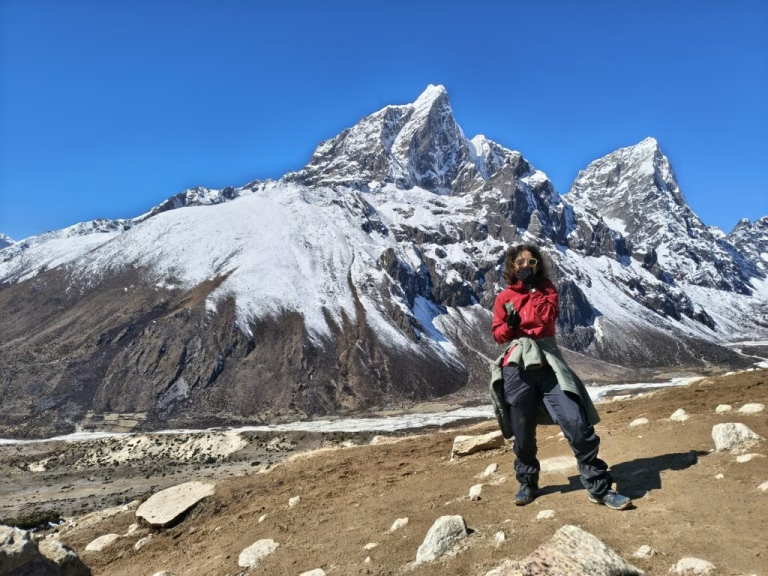
Sushila Karki is Nepal’s first female Chief Justice, serving from July 2016 to June 2017. Born on June 7, 1952, in Biratnagar, she started her legal career in 1979, became a Senior Advocate in 2007, and was appointed a Supreme Court judge in 2009. With a Master’s in Political Science from Banaras Hindu University, Karki earned a reputation for judicial independence, impartiality, and a strong stance against corruption during her tenure. Her bold judgments, often under political pressure, made her a symbol of integrity and rule of law in Nepal.
Why Gen Z Choose Sushila Karki?
Gen Z in Nepal, frustrated by corruption, nepotism, and political instability, selected Karki as their top choice to lead the country’s interim government following Prime Minister KP Sharma Oli’s resignation on September 8, 2025, amid violent protests sparked by a controversial social media ban. Over 5,000 young Nepalis participated in a nationwide virtual meeting, initially considering Kathmandu Mayor Balen Shah, but shifted to Karki after he was unresponsive. Her selection reflects the youth’s demand for a leader embodying accountability, transparency, and a break from traditional politics. Key reasons include:
- Proven Integrity: Karki’s judicial career, marked by fearless anti-corruption rulings, resonates with Gen Z’s push for clean governance.
- Non-Political Background: As a non-career politician, she represents a fresh alternative to Nepal’s entrenched political elite, appealing to a generation seeking systemic change.
- Public Support: Karki initially requested 1,000 handwritten signatures to consider the role but received over 2,500, demonstrating strong backing from the youth.
- Response to Protests: The Gen Z-led protests, which turned violent with at least 19–30 deaths and hundreds injured, were driven by demands for accountability and an end to corruption. Karki’s focus on justice for victims and their families aligns with these priorities.
- Interim Leadership: Karki emphasized forming a short-term government to organize elections within six months to a year, addressing the youth’s call for a transitional leader to stabilize the country.
Her experience, coupled with her commitment to justice and anti-corruption, makes her a trusted figure for Nepal’s youth navigating a turbulent political landscape.
Early Life and Education of Sushila Karki
- She was born on 7 June 1952, in Shankarpur, near Biratnagar, Morang District, in eastern Nepal. She is the eldest of seven siblings.
- Her education has both national and international components. She obtained her Bachelor of Arts from Mahendra Morang Campus in 1972.
- She then did her Master’s in Political Science from Banaras Hindu University (India) in 1975.
- Returning to Nepal, she studied law at Tribhuvan University, earning her LL.B in 1978.
Legal and Judicial Career of Sushila Karki
- Karki began her legal practice in 1979, based out of Biratnagar. Over time, she built a reputation for her legal work.
- She became a senior advocate in 2007.
- Her judicial career at the Supreme Court began with her appointment as an ad-hoc judge in 2009, then permanent judge in 2010.
- In July 2016, she was appointed Chief Justice of Nepal, making history as the first woman in that role. Her term lasted until June 2017.
Controversies and Challenges
- During her time as Chief Justice, she was known for a zero-tolerance policy toward corruption, and took on cases that challenged powerful political interests. This earned her both praise and opposition. (Hindustan Times)
- In 2017, lawmakers from major political parties (Nepali Congress and CPN (Maoist Centre)) filed an impeachment motion against her. The accusation involved allegedly biased decisions, especially a controversial case about appointment of a police chief. (Jagranjosh.com)
- However, the motion was later withdrawn, largely due to public pressure and legal rulings delaying or blocking the parliamentary proceedings. She eventually left the post of Chief Justice at the end of her term. (Wikipedia)
Recent Rise to Interim Prime Minister
- In 2025, following widespread protests—led largely by Gen Z—against corruption and other grievances, Prime Minister K. P. Sharma Oli resigned amid political turmoil.
- Protestors and youth groups pushed for an interim government that would be clean, nonpartisan, and capable of restoring stability. Sushila Karki emerged as a leading candidate, thanks to her reputation for integrity, her lack of political baggage, and her legal/judicial experience.
- On 12 September 2025, she was appointed as Interim Prime Minister by President Ram Chandra Poudel, making her the first woman to serve as PM in Nepal.
Personality, Values, and Public Perception
- Sushila Karki is viewed by many as a principled and upright figure, particularly for her stance against corruption and her adherence to rule of law.
- Although she has not been a politician in the usual sense (i.e. no long-party political career), her legal and judicial background gives her credibility for many across the political spectrum.
- In the protest movements, especially Gen Z, she became a symbol of change. Youth activists reportedly selected her name for leading the transitional government.
Challenges Ahead
Becoming interim prime minister is a big shift from being a judge. Some of the challenges she may face:
- Managing political expectations: The protestors expect change — less corruption, more transparency, fair governance. Balancing these expectations with the realities of Nepal’s political system will be difficult.
- Neutrality vs. politics: As someone from the judicial background, being seen as impartial is part of her legacy. But as executive leader, she will be engaging with political actors, making policy; maintaining that neutrality while getting things done is tricky.
- Stability and transition: The interim period will likely have to oversee restoring public order, ensuring freedoms, perhaps preparing for elections or forming a longer-term government. Ensuring that the transition is smooth is a big task.
- Handling institutions: Nepal has multiple power centers — political parties, the military, the bureaucracy, judiciary, civil society. Aligning them toward reform is a complex task.
Why Her Appointment Matters
- Symbolically, her appointment is historic: first woman Prime Minister, bridging judicial integrity with executive power. Many see it as a shift in how leadership is viewed in Nepal.
- Practically, at a time of crisis, people demand leaders with credibility. Her reputation for standing up against corruption is one reason protestors backed her. It offers hope for more accountable governance.
- Her example may encourage more women and non-political individuals to participate actively in Nepal’s public life, potentially altering norms.
Conclusion
Sushila Karki’s story is of someone who came from legal practice, made her way into the highest judicial office, stood firm in challenging times, and has now been entrusted with leading the country—albeit in an interim capacity. Her journey reflects both personal grit and shifting societal expectations in Nepal.
How she performs in this interim role will be scrutinized closely: it could either validate the hopes placed in her, or expose the limits of change in a system with entrenched political structures. But whatever happens, her appointment is already a turning point in Nepal’s political history.